A third model: Reef
Focus sessions that count for your habits
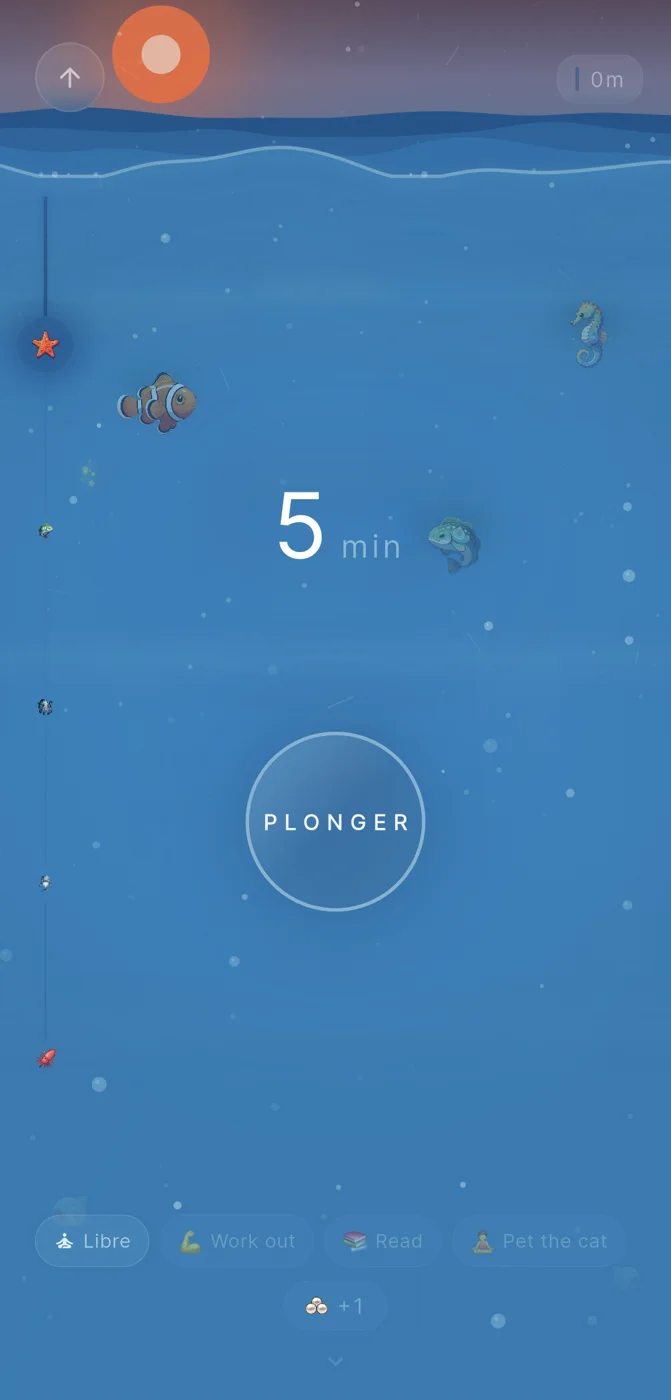
In Reef a focus session is a dive. Choose the habit it is for, put the phone down, and a completed dive releases pearls into your living ocean.
- Lock the screen and the dive keeps going. Open another app and you get a few seconds to come back before it fails.
- Strict mode is on by default. Turn it off in settings for a little more slack.
- Minutes from a dive count toward that focus habit, next to the habits you check off.
- Free plan: dives up to 25 minutes and up to 6 habits. Premium is optional.
Free download on iPhone and Android. Reef does not block other apps. It rewards the time you stay in the dive.
Start with the job the timer must do
Write down whether you need to protect one focus block, repeat habits across a week, reduce access to selected apps, or make progress visible. These are different jobs. A companion can make a timer inviting, but it does not replace a habit schedule. A habit system can record several routines, but it may be unnecessary when all you need is a quiet countdown.
Use the smallest setup that solves the real problem. Run the same twenty-five-minute task in each shortlisted app and record what happens before, during and after the session. Count setup steps, unwanted prompts and the effort required to begin again. Do not treat a charming reward or a completed timer as proof that productivity or wellbeing improved.
Compare Focus Friend and Reef as different loops
The current Focus Friend store listings describe a focus timer, app blocking, a Bean companion and decorative rewards. That model keeps attention on a bounded session. Check which blocking controls and device permissions are available on your phone, then review purchases separately in your storefront. Store features and conditions can change, so use the current listing and in-app screens as the source.
Reef combines habits and focus sessions. Its public product pages describe completed actions releasing pearls into a living ocean, focus sessions using a dive metaphor and optional social crews. Reef is not a system-wide blocking tool and should not be presented as one. It fits when one visual world for habits and focus is more useful than a dedicated timer companion.
Inspect interruption, blocking and recovery
Start a test session, switch apps, lock the phone, receive a call and intentionally end early. Record whether the timer pauses, fails, preserves partial context or applies a consequence. If app blocking matters, confirm the exact apps, schedules and override path on the operating system you use. A strict consequence may help one person and create avoidable friction for another.
Then test the next session after an interruption. The return path should be understandable without falsifying a completed session. For habit use, miss one scheduled action and check whether history remains accurate, reminders stay controllable and the next action is clear. Recovery design matters more than a perfect first-day streak because real routines include interruptions.
Separate rewards from evidence of outcomes
A knitted item, growing tree, pearl or virtual world can make recorded effort visible. Compare whether the reward explains what was completed and whether it stays optional enough to avoid becoming another task. Look for clear counts, editable goals and a way to use the core timer or tracker without sharing personal context.
Do not infer improved attention, reduced anxiety or lasting habit formation from the reward. Product events can show that a timer ended or an action was checked. They cannot establish why a person changed or whether the change will last. Keep health needs and clinical decisions outside an app comparison unless qualified evidence and professional guidance are available.
Run a seven-day reversible comparison
Choose one real focus task and one repeatable habit. Use each candidate for enough sessions to encounter a missed day, an interruption and a settings change. Record start friction, completion clarity, battery impact, accessibility, notification control and whether the reward still feels useful. Keep account and payment commitments reversible during the test.
Focus Friend, Reef, Forest, Flora and a system timer serve overlapping but non-identical jobs. Keep the one whose current controls match the job you named and whose limits you understand. You may also combine a plain timer with a separate habit list if that is clearer than putting every routine into one game layer.
Decision criteria
Use the same questions for every option before choosing.
| Option | Useful when | Check before choosing |
|---|---|---|
| Focus Friend | You want a dedicated focus timer, app blocking and a Bean companion. | Verify device-specific blocking, interruption rules, current purchases and privacy. |
| Reef | You want habits and focus sessions to build one living ocean with optional crews. | It is not a system-wide app blocker. Check whether the combined loop fits your routine. |
| Forest or Flora | You want a plant-based visual reward centred on focus sessions. | Compare interruption rules, group modes, platform availability and current terms. |
| Plain timer and checklist | You want minimal setup and separate records for focus and habits. | You give up most companion, collection and shared-world rewards. |
Frequently asked questions
Is Reef a Focus Friend clone?
No. Focus Friend is presented as a dedicated focus timer with blocking and a companion. Reef combines habit checks and focus sessions in a living ocean.
Does Reef block distracting apps?
Reef does not publicly present itself as a system-wide app blocker. Use the current product and store information rather than assuming that feature.
Which app is best for focus?
There is no universal winner. Compare the same task, device controls, interruption rules, accessibility and return path.
Can a focus reward prove better productivity?
No. It can make a recorded session visible, but it does not establish a causal productivity or health outcome.
Primary sources and evidence
- Focus Friend on Google Play 2026-08-15
- Focus Friend on the App Store 2026-08-15
- Reef product and features 2026-08-15
- Reef methodology 2026-08-15
- Forest official product page 2026-08-15
- Flora official FAQ 2026-08-15