 Reef
Reef

What people usually mean by best habit tracker google sheets
Searches for the best habit tracker google sheets usually come from people who already trust spreadsheets, want full control over their data, and don't want to pay for another app. A Google Sheets tracker is essentially a grid: rows for habits, columns for days, and some conditional formatting or checkbox logic that turns a completed cell into a visible streak. That simplicity is the appeal, but it also means the tool only does what you build into it.
Before comparing specific sheet templates, it helps to separate two different questions: whether spreadsheets are a good format for habit tracking in general, and whether a particular template is well designed. Many people conflate these and end up blaming the format when the real issue is a template that's cluttered, hard to update on a phone, or missing a way to see progress at a glance.
Strengths and real limits of a spreadsheet approach
Spreadsheets are flexible and free, which matters if you want to track unusual habits or customise scoring rules that a packaged app won't support. You can also keep everything in one place alongside other planning documents, and export or back up the data easily.
The limits are just as real. Most sheets require you to open a laptop or a clunky mobile browser view to log anything, which adds friction exactly when you're trying to build a small, repeatable habit. There's usually no gentle way to handle a missed day beyond an empty cell staring back at you, and there's no built-in mechanism for sharing accountability with other people unless you manually share the file and trust everyone to update it honestly.
These aren't reasons to avoid spreadsheets outright. They're reasons to be clear about what you need most: raw flexibility and ownership of your data, or lower friction and features built specifically for habit repetition.
A practical checklist for evaluating any tracker
Whether you're looking at a Google Sheets template or a mobile app, the same underlying questions apply. Small repeatable habits succeed or fail based on how easy they are to log, how visible progress feels over time, and how forgiving the system is when you miss a day.
Use this checklist as an example of how to evaluate any option you're considering:
- Can you log a habit in under 10 seconds from wherever you actually are, not just at a desk?
- Does the tool show progress in a way that's satisfying to glance at, not just a list of checkmarks?
- What happens after a missed day - does the system punish you, ignore it, or help you restart gently?
- If you want social accountability, is it optional, and does it avoid pressuring you toward a specific outcome?
- Can you stick with the format for months without it feeling like a chore to maintain?
A worked example: choosing between a sheet and an app
Example only. Imagine someone named Priya wants to track three habits: a short walk, ten minutes of reading, and a consistent bedtime. She starts with a Google Sheets template she found online, colour-coding each cell green when she completes a habit.
For the first two weeks it works well because she's motivated and mostly at her computer in the evenings. By week three, she starts missing entries because she's out during the day and doesn't want to open a spreadsheet on her phone. The blank cells accumulate, and looking at the sheet starts to feel discouraging rather than motivating - there's no mechanism that softens a gap in the record.
In this hypothetical, Priya's actual problem isn't willpower; it's friction and the absence of a gentle recovery mechanic. She might solve this by simplifying her sheet to reduce logging effort, or by switching to a mobile-first tool designed around quick logging and non-punitive gaps. Neither choice is objectively correct - it depends on whether she values the openness of a spreadsheet or the lower friction of a dedicated tool more.
Where an app like Reef fits into this decision
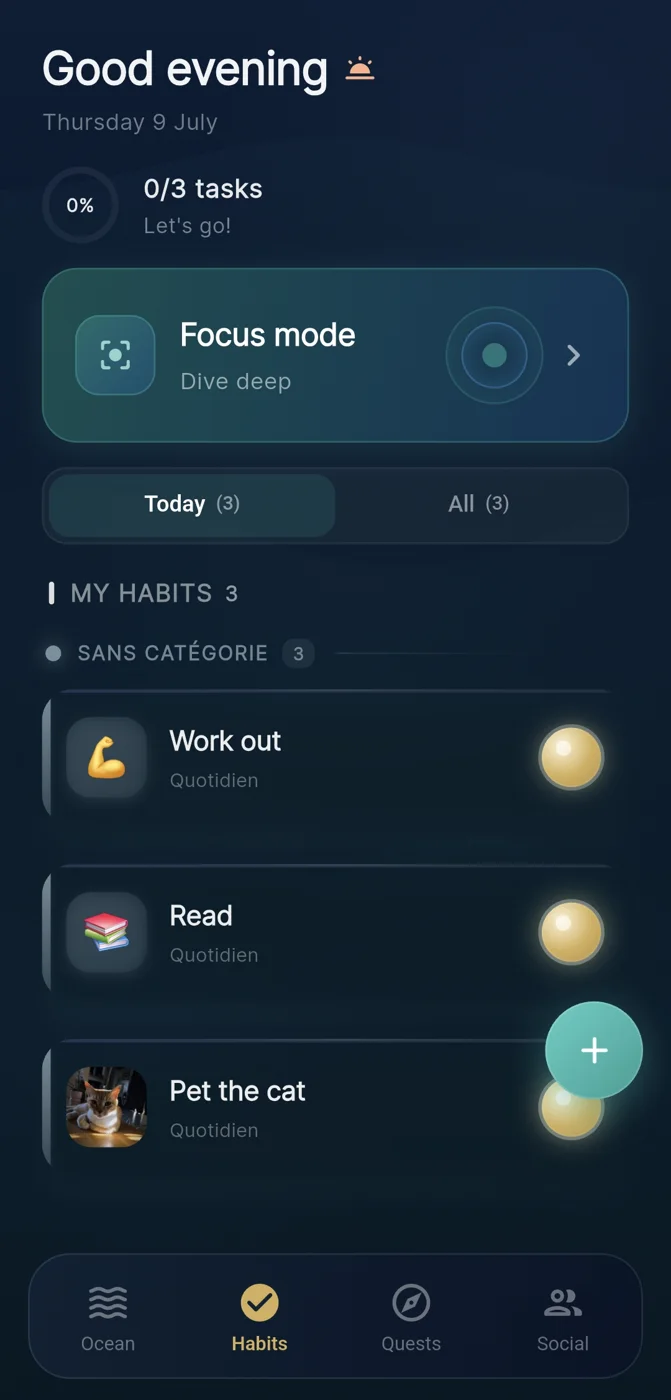
Reef is a mobile habit tracker from IVRYN, available on iOS and Android, and it approaches the same underlying problem - making repeated small actions visible - differently from a spreadsheet. Completing a habit in Reef adds a pearl to a visual ocean scene that builds up over time, which gives an at-a-glance sense of progress without requiring you to read a grid of dates. It also includes timed focus sessions, framed around a diving metaphor, that reward completed focus periods with additional pearls.
If accountability matters to you, Reef offers optional crews so you can share progress with others by choice rather than by default. None of this guarantees a particular behaviour change or health outcome, and it isn't a replacement for judgment about what habits are realistic for your life - it's simply a different way of making the same small-habit principles (visibility, repeatability, gentle recovery) tangible on a phone rather than in a spreadsheet cell.
Deciding what actually fits your search for best habit tracker google sheets
If you searched for the best habit tracker google sheets, you're likely drawn to control, cost, and familiarity with the tool. That's a legitimate starting point, and a well-built sheet can absolutely support small repeatable habits if you're disciplined about logging and comfortable designing your own gentle-recovery rules - for example, deciding in advance that missing one day doesn't reset a streak counter.
If, after trying a sheet, you notice the friction of logging or the harshness of an empty cell is undermining your consistency, that's a signal worth acting on rather than ignoring. Switching tools mid-stream isn't a failure; it's an adjustment based on what you've learned about your own habits.
Frequently asked questions
Is a Google Sheets habit tracker better than an app?
Neither is universally better. Spreadsheets offer flexibility and free customisation but usually add friction to daily logging and lack built-in accountability or recovery features. Apps typically reduce friction and add visual or social mechanics, but with less customisation. The right choice depends on which trade-off matters more to you.
How do I handle missed days in a spreadsheet habit tracker?
Decide on a rule in advance, such as not resetting a streak counter after a single missed day, and build that logic into your sheet with conditional formatting or a simple formula. Without a deliberate rule, blank cells can feel discouraging and make it harder to restart.
Does using a habit tracker guarantee I'll build a new habit?
No tracker, spreadsheet or app, guarantees a behaviour or health outcome. Tools like Reef make progress visible and can support small repeatable actions, but sustained habit change also depends on factors like realistic goal-setting and your broader routine, which no tracker controls.
Sources and further reading
These resources provide the wider reference frame. Product statements on this page are limited to the public information provided by Reef.