 Reef
Reef

What a gamified habit tracker in Google Sheets free actually gives you
People who search for a gamified habit tracker in Google Sheets for free usually want two things at once: no cost, and some sense of reward. A spreadsheet can deliver both, but only to the extent that you design the game yourself. Sheets gives you a grid, checkboxes, formulas and conditional colours. Points, levels, streaks and badges exist only if you build them.
That makes the question less about which template to download and more about what you need the tracker to do. If you want a private, fully customisable log and enjoy tinkering, a spreadsheet is a reasonable choice. If you want reminders, a reward loop that feels alive, or a gentle response when you miss a day, you will be doing extra work to approximate those features.
Before acting, it helps to check the current terms of whatever you rely on. Google Sheets access is tied to a Google account, and the features or limits of any service can change over time, so treat any template or tool description as a snapshot rather than a permanent fact.
Building the basic sheet: checkboxes, counts and colour
A workable starting layout puts dates down the first column and one habit per column across the top. Insert checkboxes in the grid so each cell is simply ticked or unticked. A single row at the bottom can count completions for each habit with a COUNTIF formula that counts TRUE values.
The game layer comes from feedback you can see. Conditional formatting can turn a ticked cell a colour you like, and a points column can multiply completions by a value you assign to each habit. A simple level system can be a formula that divides total points by a threshold and rounds down. None of this is complicated, but each piece is something you maintain.
Keep the first version small. Two or three habits are easier to keep up with than ten, and a sheet that looks unfinished is more likely to be abandoned than one that is simple and complete.
- Column A: dates, one row per day
- Columns B onward: one habit each, with checkboxes
- Bottom row: COUNTIF for completions per habit
- Points column: completions multiplied by a value you choose
- Conditional formatting: a calm colour for completed cells
Where the spreadsheet game layer runs thin
The main limit is that a spreadsheet only reacts when you open it. There is no built-in nudge at the time you planned to act, so the tracker records habits rather than prompting them. Scripts can add reminders, but that moves the project from a tracker into a small software build.
The second limit is how missed days look. A streak formula usually resets to zero after a blank cell, and an empty row in a grid can feel like a verdict. That is a design choice, not an inevitability, but you have to make it deliberately. The third limit is sharing: giving a friend access to a sheet often exposes the whole file, and editing on a phone can be fiddly enough to discourage quick check-ins.
None of these is a reason to avoid spreadsheets. They are reasons to decide in advance what you will accept, so you do not quietly drop the tracker the first time it becomes inconvenient.
Designing for small habits and gentle recovery
Whatever tool you use, the habits themselves matter more than the scoring. Small, repeatable actions are easier to record honestly than ambitious ones, so define each habit at a size you could manage on a tired day. A habit like reading two pages is easier to keep visible than reading a chapter.
Recovery after a missed day is worth building in explicitly. In a spreadsheet you could add a column for a limited number of rest days per month, and adjust your streak formula so a marked rest day does not break the count. That one change turns the sheet from a pass-or-fail record into something closer to a pattern you can return to.
Social accountability works best as an option rather than a requirement. If you share progress, consider sharing only a summary tab rather than the full log, so you control what others see.
Example decision aid: spreadsheet or dedicated app?
Worked hypothetical, for illustration only: someone wants to track water, a short walk and twenty minutes of focused study. They enjoy formulas, rarely miss a day, and do not want to share progress. A Google Sheet with checkboxes, a points column and a rest-day column would likely cover their needs without extra tools.
Change the hypothetical: the same person studies on their phone, often forgets until evening, wants to protect focus blocks and would like a friend to see progress occasionally. Now the spreadsheet needs reminders, mobile-friendly input, a focus timer and selective sharing, each of which is extra setup. A dedicated habit app becomes the simpler path, provided its data and pricing terms suit them.
- Do you mostly track on a computer? A sheet fits well.
- Do you need prompts at a set time? Plan for scripts or an app.
- Will missed days discourage you? Build rest days in from the start.
- Do you want to share only part of your progress? Use a separate summary view or an app with optional groups.
- Do you enjoy maintaining formulas? If not, the free sheet has a hidden time cost.
Where Reef fits, and the limits of this advice
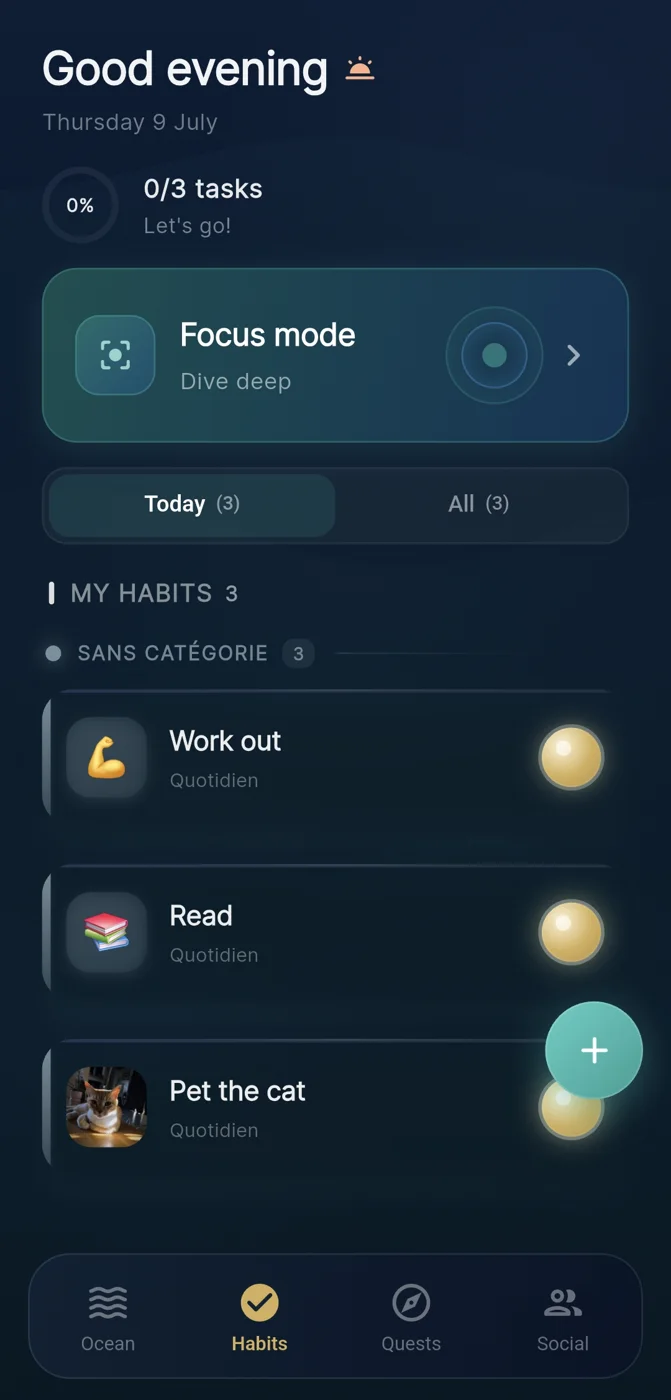
Reef is a mobile habit tracker from IVRYN for iOS and Android, so it suits readers in the second hypothetical rather than those happy with a spreadsheet. Its approach is to make progress visible: each completed habit adds a pearl to an ocean scene, longer focus sessions take you into deeper zones, and a streak freeze covers an off day. It is free to start, carries no ads and does not resell data, and joining a crew is optional.
This article is bounded by that public context. Reef has not tested spreadsheet templates or competing apps for this piece, and no tool, Reef included, can guarantee a change in behaviour or health. The approach to habit design is described on Reef's methodology page, and its guide to gamified habit tracker apps covers the app route in more depth.
Frequently asked questions
Can I make a gamified habit tracker in Google Sheets for free?
Yes, if you have a Google account you can build one with checkboxes, COUNTIF formulas, a points column and conditional formatting. The game elements, such as points, levels and streaks, need to be designed and maintained by you, and it is worth checking current Google terms before relying on the service.
How do I stop a missed day from breaking my spreadsheet streak?
Add a rest-day column with a monthly limit and adjust the streak formula so a marked rest day counts as neutral rather than as a break. This keeps recovery gentle and makes it easier to return after an off day without starting from zero.
When is a habit app a better choice than a habit tracker spreadsheet?
An app is usually simpler if you need timed reminders, track mostly on a phone, want a focus timer or prefer to share progress selectively. A spreadsheet suits people who track on a computer, enjoy customising formulas and do not need prompts. Neither option guarantees that a habit will stick.
Sources and further reading
These resources provide the wider reference frame. Product statements on this page are limited to the public information provided by Reef.