 Reef
Reef
What the best habit forming strategies actually have in common
When people search for the best habit forming strategies, they're usually hoping for a shortcut: one technique that finally makes a habit stick. In practice, the strategies that hold up over months share a narrower set of traits than most advice implies. They shrink the habit down to something almost trivially easy to start, they make progress visible in some way, and they build in a way to recover after an inevitable missed day rather than treating a lapse as failure.
None of this depends on willpower spikes or motivation. A strategy that only works when someone feels inspired is not really a strategy for daily life, where energy and attention fluctuate. The more durable approaches assume low motivation as the default state and design around it, which is why 'small' and 'repeatable' tend to matter more than 'ambitious' and 'impressive'.
Principle one: make the habit small enough to repeat without negotiation
The first reliable strategy is reducing the habit to a size where there is nothing left to argue about. A two-minute stretch, a single paragraph written, or one glass of water logged removes the daily negotiation that derails bigger commitments. The goal at the start is repetition, not intensity, because intensity is what people abandon first when a day gets busy.
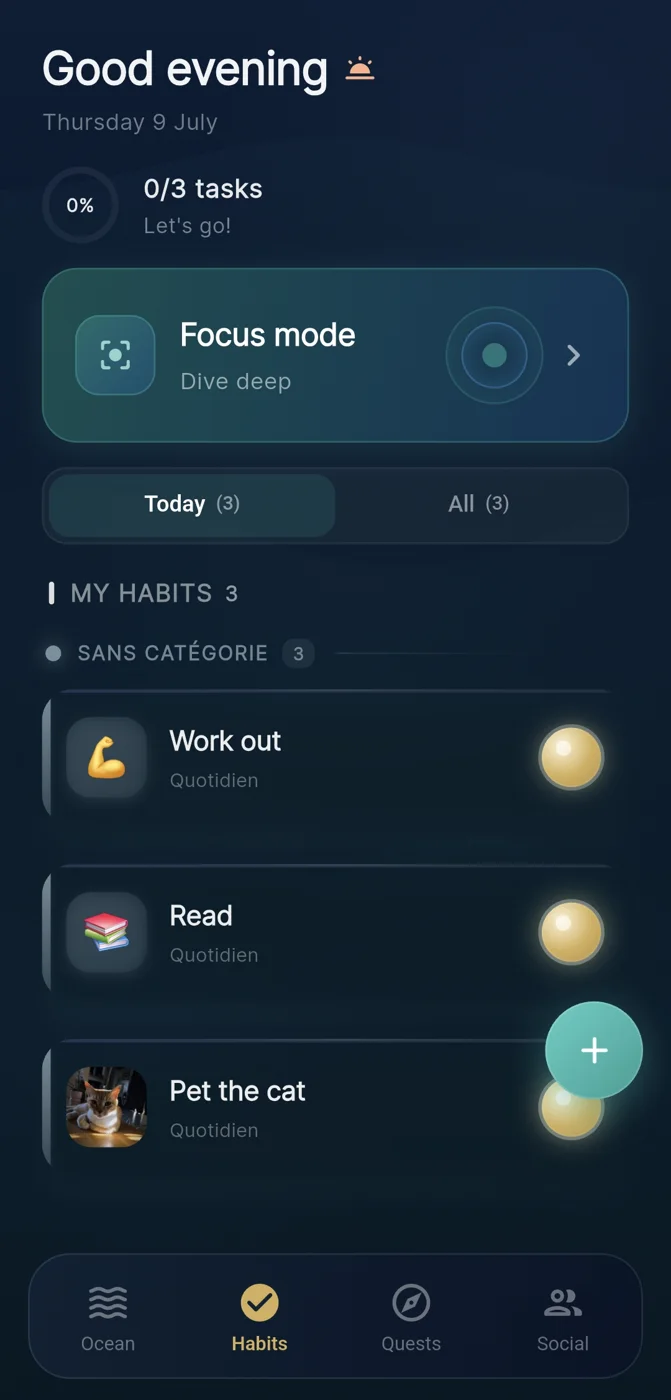
This is where a visual layer can genuinely help rather than just decorate the process. Seeing a habit marked as done, even in a small or playful way, gives the brain a concrete signal that something happened, which is different from just trusting that it happened. Reef, an IVRYN mobile habit tracker, builds this into its core mechanic: finishing a habit adds a pearl to an ongoing visual scene, so the record of consistency is something a person can actually look at rather than infer from memory.
Principle two: protect focus time as its own habit
Habit strategies often focus on recurring actions like exercise or reading, but protecting a block of undistracted time is itself a habit worth forming separately. Many goals fail not because the habit itself is hard, but because the person never carved out an uninterrupted window to do it. Treating focus time as a scheduled, repeatable event, rather than something that happens if the day allows it, is one of the more underrated strategies in this space.
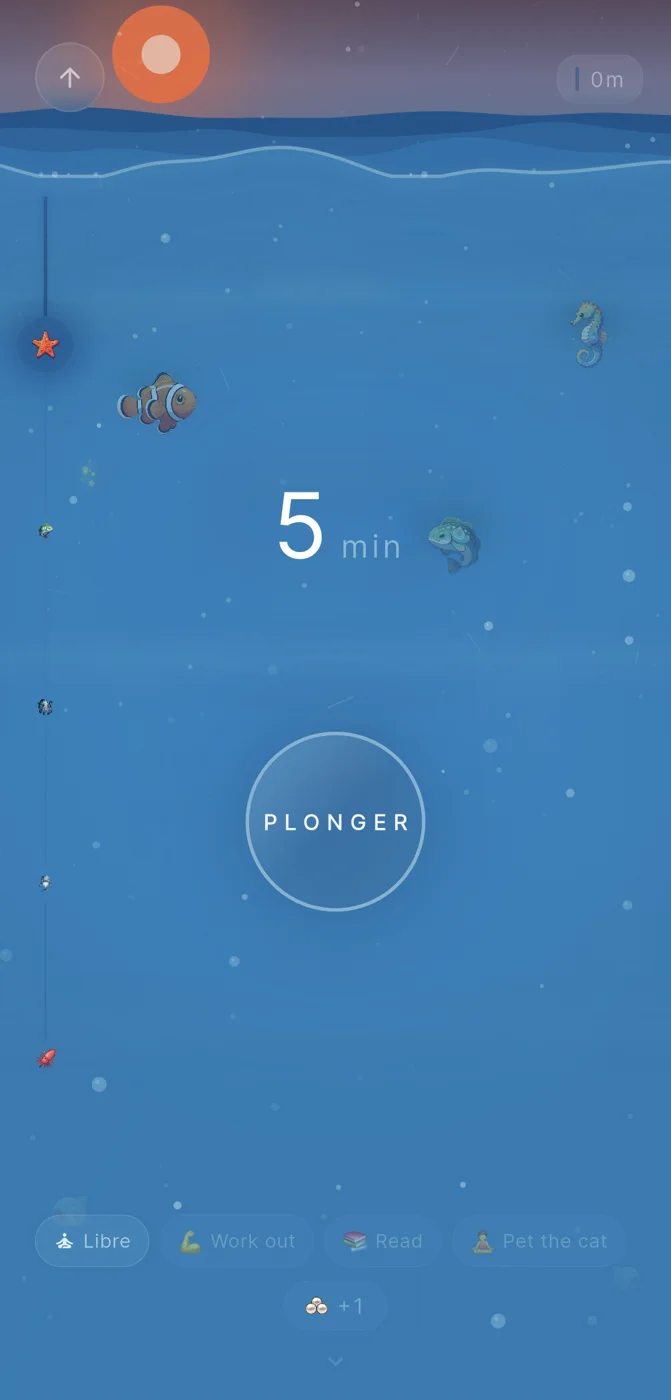
Some tools frame this focus window with a metaphor to make the commitment feel more concrete, similar to how a timer or a ritual can signal 'this period is protected.' Reef uses a dive metaphor for its focus sessions, where completed focus time is rewarded with pearls in the same visual system used for habits. That framing doesn't change the underlying discipline required, but it gives the block of time a clearer start and end, which can make it easier to actually protect.
Principle three: design for gentle recovery, not perfect streaks
Almost every habit strategy eventually meets a missed day, and what happens next often determines whether the habit survives. Approaches built around unbroken streaks can backfire, because a single lapse can feel like the whole effort is voided, which paradoxically makes people quit entirely rather than just skip one day. A better strategy treats a missed day as data, not a verdict, and makes it easy to simply resume the next day without penalty or a reset to zero.
This is a design question as much as a psychological one. If a tracking system visibly punishes a missed day, harshly resets progress, or requires re-earning lost status, it teaches the person to fear the tracker itself. Systems that let a habit record continue accumulating, missed day included, tend to support longer-term consistency better than systems built purely around perfect completion.
Principle four: use optional social accountability, not mandatory pressure
Sharing progress with others can help some people stay consistent, but it is not a universal requirement for habit formation, and treating it as mandatory can add pressure that undermines the habit itself. The most sustainable version of social accountability is opt-in: available for someone who wants a nudge from a friend or a small group, but not a barrier for someone who prefers to track privately.
Reef reflects this by making its crew feature optional rather than central to using the app, and it does not claim that social accountability guarantees a particular behaviour or health outcome for any individual. That distinction matters for anyone evaluating habit strategies: social pressure can be a useful accelerant for some people, and unnecessary friction for others, so a good strategy should not force one approach on everyone.
A worked example: applying these principles to a two-week habit trial
To make these principles concrete, consider a hypothetical reader, Dana, who wants to build a daily reading habit. This is an illustrative example only, not a documented case or outcome.
In week one, Dana sets the habit deliberately small: read for five minutes after breakfast, logged the moment it's done. Dana also blocks a ten-minute focus window at the same time each day, treating it as a fixed appointment rather than something to fit in later. By day four, Dana misses a day due to travel. Instead of restarting a streak count, Dana simply logs the next day's five minutes and moves on, treating the gap as expected rather than a failure.
In week two, Dana experiments with sharing progress in a small optional group chat, and finds it mildly motivating on slow days but unnecessary on days when the habit already feels automatic. By the end of two weeks, the habit is not dramatic, but it is repeatable, visible, and resilient to an occasional missed day.
- Shrink the habit to the smallest version that still counts as done
- Schedule focus time as a fixed block, not a 'when I get to it' task
- Let missed days continue the record instead of resetting it
- Treat social sharing as optional, adjusted to what actually helps you
Where these strategies have limits
No habit strategy, including the ones described here, guarantees a specific behaviour change or health outcome for a given individual, and it would be misleading to suggest otherwise. Habit formation is influenced by factors well beyond any app or technique, including sleep, stress, environment and unrelated life events, and a visual or gamified system is a support structure, not a substitute for those broader conditions.
It's also worth being honest that a tool like Reef is scoped specifically to habits, focus sessions and optional social accountability within a mobile app; it is not a medical, therapeutic or performance-guarantee product, and this article does not offer medical or clinical advice. Anyone dealing with a health condition connected to a habit goal should treat that as a separate conversation with a qualified professional, not something a tracking app resolves on its own.
Frequently asked questions
What is the single most important factor in the best habit forming strategies?
Making the habit small enough to repeat without much deliberation tends to matter more than any other single factor, since consistency compounds over time far more reliably than occasional intense effort.
Should I stop a habit tracker if I miss several days in a row?
No; a well-designed approach treats missed days as expected setbacks rather than reasons to quit, and simply resuming the habit the next day is generally more effective than abandoning the tracker or the habit entirely.
Is social accountability necessary to form a habit?
It's helpful for some people but not required for everyone; social accountability should be treated as an optional accelerant rather than a mandatory component, since forced sharing can add pressure that works against habit formation for people who prefer privacy.
Sources and further reading
These resources provide the wider reference frame. Product statements on this page are limited to the public information provided by Reef.