 Reef
Reef

What a habit tracker zum ausdrucken is for
A habit tracker zum ausdrucken is a printable page used to mark whether you completed a chosen action on particular days. It is most useful when the action is small, clear and repeatable: taking a short walk, preparing tomorrow’s lunch, reading a few pages or setting aside a period for focused work.
The page is a record, not a verdict. A row of marked days can make repetition easier to notice, while blank spaces can show where a routine did not fit real life. Neither pattern proves that a habit has been formed or that a particular wellbeing result will follow.
Before printing anything, decide what you want the sheet to help you see. A monthly grid is useful for noticing broad consistency; a weekly sheet can be better when you want to adjust quickly. The right format is the one you will actually look at and update.
- Choose one action that can be described in a single sentence.
- Define what counts as completion before the week begins.
- Keep the tracker where the action or its cue is easy to notice.
How to choose a printable tracker that supports repetition
Start with a modest target rather than an idealized routine. A tracker works best when completion is observable and the threshold is realistic on ordinary days. “Put on walking shoes and go outside for five minutes” is clearer than “be healthier,” because you can mark it without interpreting your mood or judging the day.
Match the page to the rhythm of the habit. Daily actions may suit a calendar-style grid. Actions that happen two or three times per week often need planned slots rather than empty boxes that look like failures. If focus is the priority, a tracker can record sessions or minutes, but it should not turn every interruption into a reason to abandon the plan.
Visual design matters because it affects whether you return to the page. Use enough space to read the labels, a simple marking method and no more habits than you can reasonably review. A crowded tracker can create administration work instead of practical feedback.
- Use a weekly layout for experiments and early adjustments.
- Use symbols only when their meaning is written down.
- Limit the first version to one to three habits.
Using a habit tracker zum ausdrucken without turning it into pressure
The most constructive use of a printable tracker is brief and regular: mark the action, notice the pattern, then make one small adjustment. Reviewing once a week is usually more useful than repeatedly calculating a perfect streak. The point is to learn which cues, timing and expectations make the action easier to repeat.
Missed days are information, not evidence that the effort is over. Ask a practical question: was the action too large, the reminder poorly placed, the time unsuitable, or was the day simply unusual? A gentler recovery plan might be to return with a smaller version of the action at the next available opportunity.
Avoid treating an unbroken sequence as the sole measure of success. A streak can be motivating, but it can also make one missed day feel disproportionately important. Leaving room on the sheet for a short note - such as “travelling,” “ill,” or “moved to evening” - can preserve context and make the next decision more realistic.
- Review the sheet at a planned time each week.
- After a missed day, choose the next smallest useful action.
- Change one variable at a time when adjusting the routine.
Example decision aid: choosing a first printable setup
Example: Maya wants to protect focus time for a personal project and also remember a short evening reset. She initially considers tracking five habits every day, but decides that two are enough for a two-week trial. She prints a weekly page with one row for a 25-minute focus session and another for a five-minute evening reset.
For the focus row, Maya marks a day only after completing one planned session. For the reset row, she marks completion after putting away the items she chose in advance. She adds a small notes column because a blank box without context would not tell her whether the plan was unrealistic or merely interrupted.
At the end of the first week, Maya sees that morning focus sessions happened more often than afternoon sessions, while the evening reset was skipped on late workdays. Her decision is not to demand perfect adherence. She moves the focus cue to the morning and changes the reset target to three minutes on late days. The tracker has helped her make a narrower, usable adjustment; it has not guaranteed that either action will become automatic.
- Write the completion rule beside each habit.
- Set a review date before starting.
- Decide in advance on a smaller fallback version for difficult days.
When paper is enough, and when a visual app may help
A printable tracker is often enough when you want a low-tech, private record and enjoy a physical cue. It has useful limits: it can be misplaced, does not automatically travel with you and may be less convenient when you want to combine several types of activity or revisit longer patterns.
A digital tool can make sense if visual feedback helps you return to the practice, if you want to keep habit and focus records together, or if you want accountability with people you already trust. The choice should be based on fit, not on a promise that an app will produce a behavioural or health result.
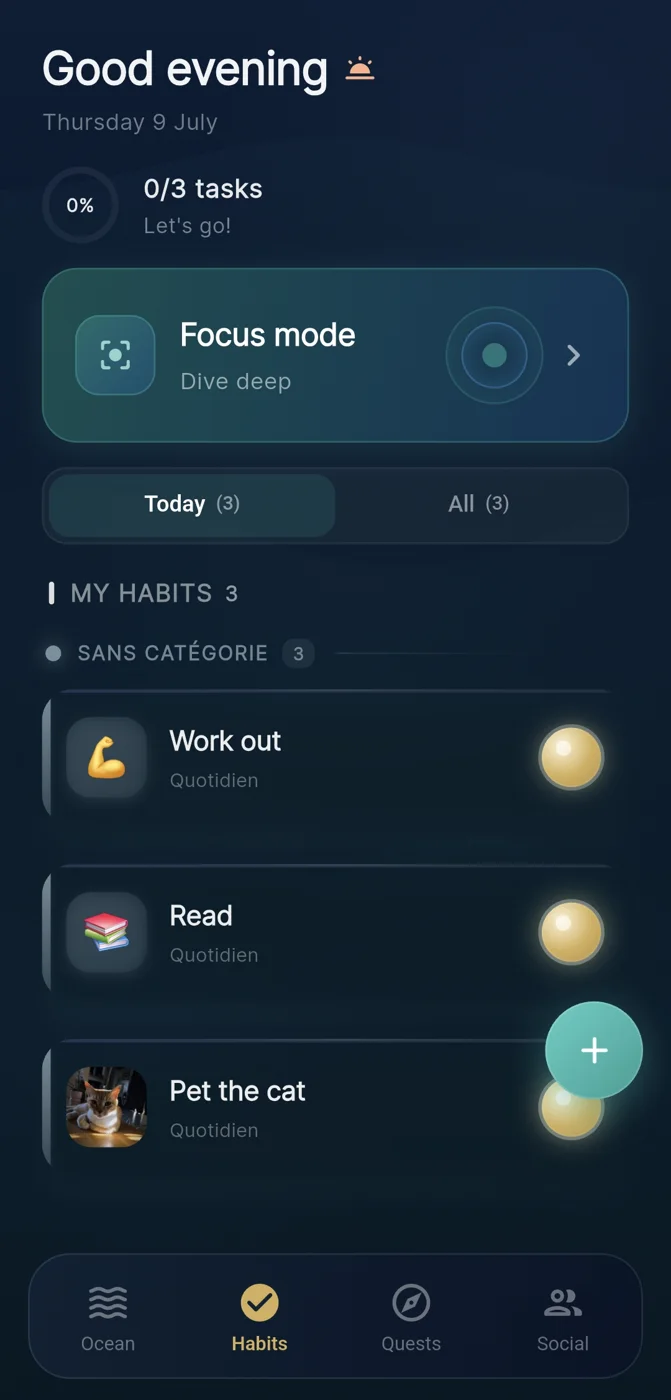
Reef is an IVRYN mobile habit-tracking app for iOS and Android that represents completed habits as pearls added to an evolving ocean scene. Its focus mode frames a completed concentration period as a dive and adds pearls for finished focus time. Its social crews are optional, so accountability can remain private unless a person chooses to share it. Reef’s public methodology describes its habit-design framing and evidence boundaries; it does not establish guaranteed outcomes for individual users.
- Choose paper for a simple visible prompt in one place.
- Choose digital tracking when portable visual records better fit your routine.
- Treat optional social features as a preference, not a requirement.
Limits to keep in mind before you act
A tracker can show what you marked; it cannot fully explain why a habit was difficult, measure every relevant part of your life or replace support needed for a serious health concern. If a goal relates to physical or mental health, use the tracker only as an organizational aid and seek appropriate professional support when needed.
Be cautious with false precision. Marking a box can simplify a complex activity, which is useful only if the rule remains honest and clear. For example, a focus-session mark can represent a completed planned block, but it should not be read as proof of productivity, learning quality or long-term change.
Finally, give the experiment an endpoint. After two to four weeks, ask whether the tracker reduced friction, clarified your next step or became another obligation. Keep the useful parts, simplify what is burdensome and stop using the format if it no longer serves the action you care about.
- Do not use marks as a diagnosis or a measure of personal worth.
- Keep completion rules simple enough to apply consistently.
- Reassess the tracker instead of assuming it must be permanent.
Frequently asked questions
What should I put on a habit tracker zum ausdrucken?
Put one to three small, observable actions on a printable habit tracker, define what counts as completion, and use a layout that matches how often each action is planned.
How do I recover after missing days on a printable habit tracker?
Treat missed days as a cue to review timing, cues or the size of the action, then return with the smallest practical next step instead of trying to erase the gap.
Can a visual habit-tracking app replace a printable tracker?
A visual app can be a useful alternative when portable records, combined focus tracking or optional accountability suit your routine, but neither an app nor a printable tracker can guarantee behaviour or health outcomes.
Sources and further reading
These resources provide the wider reference frame. Product statements on this page are limited to the public information provided by Reef.