 Reef
Reef

What habit tracking journal ideas are for
Habit tracking journal ideas can help turn an intention into a record of repeated action. Before choosing a format, decide what you want the journal to make easier: remembering a small action, seeing a pattern over time, protecting a period of concentration, or inviting accountability from someone else.
A journal is not proof that a habit will stick, and a completed box is not a verdict on your character. Its useful role is narrower: it gives you a visible prompt, a simple place to record what happened, and information you can use to adjust the next attempt.
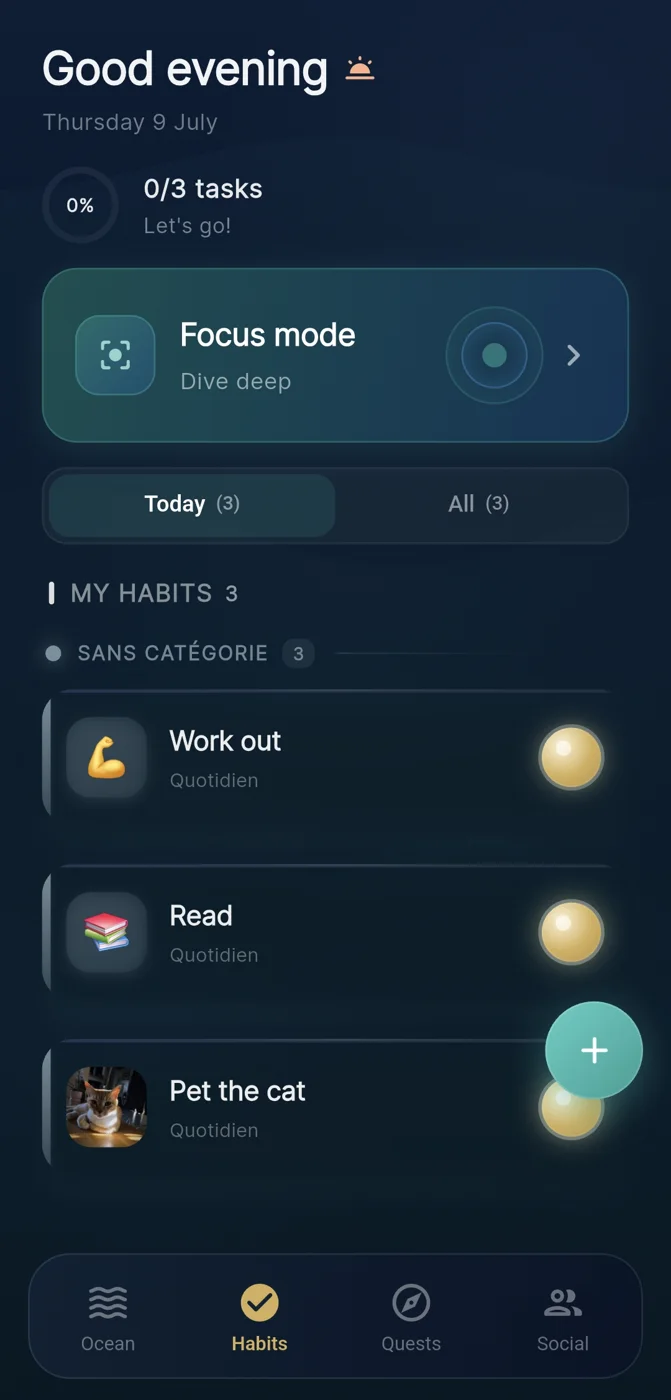
Reef is an IVRYN mobile habit tracker for iOS and Android. Its public approach is relevant here because it makes repeated actions visible through an ocean-themed system, while presenting habit support without a promise of a particular behavioural or health result.
- Start with one behaviour you can describe clearly, such as “read one page” or “prepare tomorrow’s water bottle.”
- Choose a record that takes less time than the habit itself.
- Review the record to learn, not to punish yourself.
Begin with a small repeatable action
The strongest starting point is usually a behaviour small enough to repeat on an ordinary, inconvenient day. “Exercise more” leaves too many decisions open; “put on walking shoes after lunch” creates a concrete next step. A journal works better when it records an action rather than a broad aspiration.
Keep the first version deliberately modest. You can expand a routine after it has a place in your day, but an ambitious tracker can become another task to avoid. Define a minimum version that still counts, then distinguish it from an optional fuller version in a note if that helps.
A helpful prompt is: what can I do even when time, energy, or motivation is limited? The answer is often the habit worth tracking first. This does not guarantee repetition, but it reduces the friction between deciding and doing.
- Name the cue: “after breakfast.”
- Name the minimum action: “write one sentence.”
- Name the location or object needed: “notebook on the kitchen table.”
Make progress visible without making it heavy
Visibility is the main advantage of a habit journal. A calendar mark, short check-in, colour-coded line, or digital record can show that one small action has happened more than once. That evidence can be more useful than relying on memory, especially when progress feels slow.
Avoid recording more detail than you will realistically revisit. If sleep, mood, weather, or context is relevant, add one brief tag rather than a full diary entry. The aim is to reveal a workable pattern: which cues help, which days are difficult, and whether the habit definition needs changing.
In Reef, marking a habit complete releases a pearl that adds to a visual ocean. That is one example of making the record feel tangible: completion contributes to an evolving scene rather than only increasing a numerical total. The value is in seeing your own recorded actions, not in treating the visual as evidence of guaranteed change.
- Use one mark for completion and one optional note for context.
- Look for trends across several attempts, not meaning in a single missed day.
- Keep the display easy to scan at a glance.
Habit tracking journal ideas for focus sessions
A habit journal can also support focus time when the tracked action is a protected session rather than an outcome. Record a planned start, a realistic duration, and a short closing note such as “stopped when timer ended.” This keeps the emphasis on showing up for the session rather than demanding a perfect result.
Use a dive metaphor only if it helps you separate a focus period from everything competing for attention. Before starting, choose one task, put distractions out of reach where possible, and decide what will signal the end. Afterward, write whether the duration felt too short, suitable, or too demanding, then adjust the next session.
Reef frames focus sessions as dives and awards pearls for completed focused time. That can make the passage of a session more visible in the same ocean setting as habits, but it does not establish that using a timer or a reward system will improve concentration for every person.
- Example focus entry: “10:00, 20 minutes, outline project brief, phone in another room.”
- End with one sentence: “Next time, start with the first heading.”
- If a session is missed, schedule a smaller next attempt instead of trying to compensate with an extreme one.
Plan for missed days and gentle recovery
A useful tracker includes a recovery rule before you need it. Missed days are data about real conditions: travel, illness, competing responsibilities, unclear cues, or a habit that was too large. Treating them as failure can make the journal harder to reopen.
Try a “return, don’t repay” rule. If you miss a planned action, do not assume you must double the next one. Return to the minimum version at the next reasonable cue. If several attempts are missed, revise the trigger, the size of the action, or the environment rather than simply increasing pressure.
Gentle recovery does not mean ignoring a pattern you want to understand. A weekly review can ask: Was the action clear? Was the cue present? What obstacle appeared? What is one smaller or better-timed version to try? The journal becomes useful when it supports this kind of practical adjustment.
- Missed once: resume the next planned opportunity.
- Missed repeatedly: reduce the minimum action or change the cue.
- Feeling discouraged: review what was completed as well as what was skipped.
Use optional accountability with clear boundaries
Some people find it helpful to share a plan or a simple check-in with a friend, while others prefer a private record. Accountability is most useful when it is chosen, specific, and easy to decline. Agree on what will be shared, how often, and what kind of response is welcome.
Keep the social request modest. For example, two people might send a weekly message stating one habit they plan to repeat and one adjustment they will make. Avoid turning a check-in into surveillance, comparison, or a demand to explain every missed day.
Reef offers optional social crews, so shared accountability can be part of the experience if a person wants it. Participation is not required, and the presence of a crew should not be interpreted as a guarantee of a behavioural or health outcome.
- Ask: “Would you like one weekly check-in?”
- Share commitments rather than scores when comparison is unhelpful.
- Set a kind default response to missed days: “What would make the next attempt easier?”
Example decision aid: choose a journal design
Example: Maya wants to read more, protect short writing sessions, and avoid abandoning her plan after a busy week. She chooses two entries rather than tracking every aspiration: “read one page after dinner” and “complete a 20-minute writing session twice a week.” Her journal has a daily completion mark, a focus-session line, and one optional context note.
For recovery, Maya writes: “If I miss a day, I restart at the next cue with the minimum version.” For accountability, she asks a friend whether they would like to exchange one weekly intention and one brief reflection. The friend can say no, and neither person is expected to report every detail.
This design is appropriate because it is small, visible, and adjustable. If Maya consistently skips reading after dinner, she can move the cue or reduce the action; if 20 minutes of writing is too difficult, she can try ten. The journal helps her make these decisions, but it cannot promise that either routine will become permanent.
- Choose one or two habits, not a full life overhaul.
- Write a minimum version and a recovery rule.
- Decide whether privacy or optional shared check-ins suit you better.
- Review weekly and change the system when the evidence in your own record calls for it.
Frequently asked questions
What are good habit tracking journal ideas for beginners?
Good beginner ideas use one or two actions that are concrete and small, such as reading one page after dinner or putting out exercise clothes before bed. Record completion with a quick mark, define a minimum version, and add a simple plan for returning after a missed day.
Should a habit tracking journal include missed days?
Yes. Recording missed days can show where a cue, schedule, or habit size needs adjustment. Treat a missed entry as information rather than a reason to compensate or abandon the journal, and return to the smallest workable version at the next opportunity.
Can social accountability guarantee that I will keep a habit?
No. Optional check-ins can provide structure or encouragement for some people, but they cannot guarantee a behaviour or health outcome. Choose clear, low-pressure agreements and keep a private tracking option if sharing is not helpful.
Sources and further reading
These resources provide the wider reference frame. Product statements on this page are limited to the public information provided by Reef.