 Reef
Reef

What an appropriate daily routine really means
An appropriate daily routine is not the most productive schedule you can imagine. It is the set of actions that fits the life you actually have: your working hours, energy, caring duties, budget and health. A routine copied from someone with different constraints can be well designed and still be wrong for you.
Before acting on any template, the useful question is how the routine will behave on an ordinary, slightly difficult day, not whether it looks impressive. If it only works when everything goes smoothly, it is a wish list rather than a routine. Appropriateness is judged over weeks, not on the first enthusiastic morning.
Questions to answer before you design a routine
Start with constraints rather than goals. Fixed commitments, the hours when your attention is usually strongest, and the points where your day reliably falls apart all shape what is realistic. A routine that ignores these tends to collapse at the same moment each day, which can feel like personal failure when it is really a design problem.
Then decide what the routine is for. Protecting a block of focused work, repeating a small personal habit and staying in touch with people are different aims, and they rarely belong in the same time slot. Naming the purpose makes it easier to cut anything that does not serve it.
- Which hours are already committed, and which are genuinely free?
- When is your attention usually best, and when is it lowest?
- What is the one outcome this routine should support?
- What tends to derail your day, and how often?
Start smaller than feels worthwhile
Small repeatable habits are easier to judge than ambitious ones because you can see whether they happen at all. Ten minutes of reading that occurs most days tells you more about fit than an hour that occurs twice. Once the small version is stable, you can extend it with evidence rather than optimism.
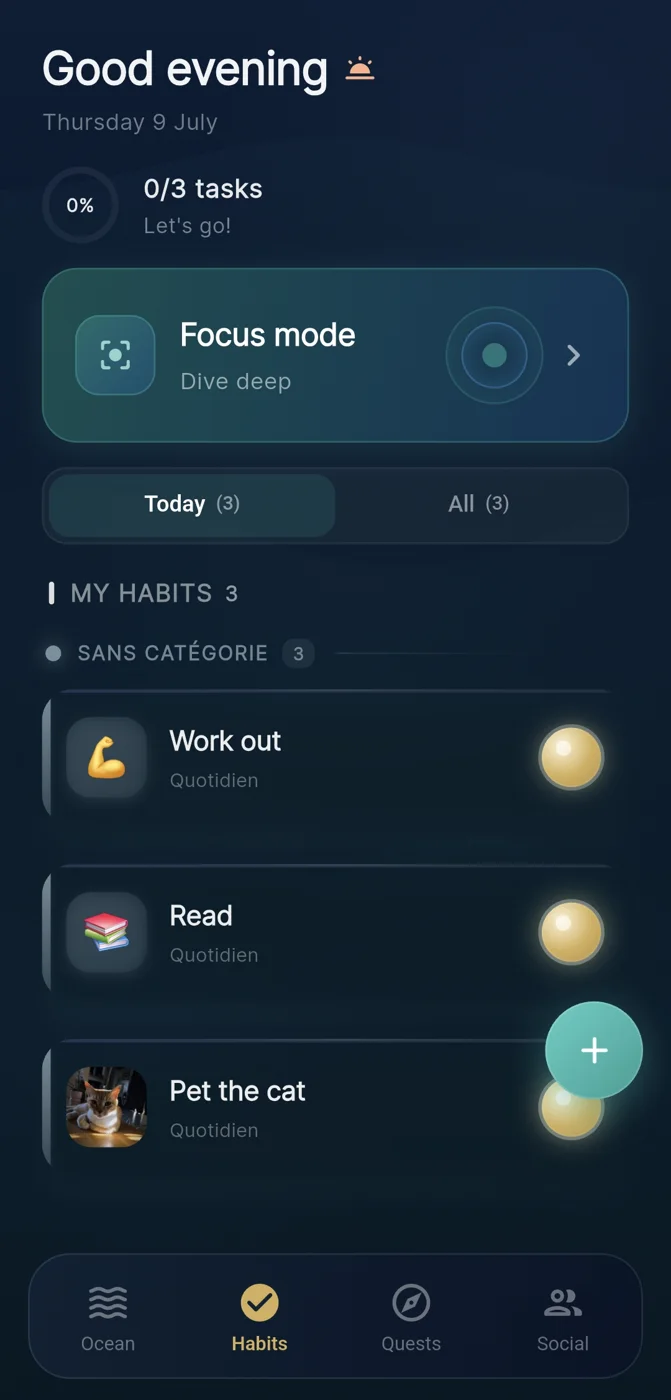
Visible progress helps here, because a routine is otherwise mostly invisible: a few minutes here, a skipped task there. Recording completions, whether on paper or in an app, turns scattered actions into a pattern you can review honestly. The record is a mirror, not a verdict, and its job is to show you what to adjust.
Plan for missed days before they happen
Every routine meets days when it does not happen: illness, travel, a bad night, an urgent request. An appropriate routine includes a rule for those days in advance, such as doing a minimal version or simply resuming tomorrow. Without that rule, one gap often becomes several, because restarting feels like admitting defeat.
Gentle recovery matters more than perfect streaks. This is the area where Reef, a habit tracker from IVRYN for iOS and Android, is deliberately designed: a streak freeze can cover an off day, and its shrimp companion Gambi responds to both completed and missed days without blame. Reef's public methodology frames these mechanics as ways of making repetition visible, not as a guarantee that your behaviour will change.
Treat accountability as a choice, not a default
Sharing a routine with other people helps some readers and adds pressure for others. If knowing that someone will notice keeps you going, a small group can be useful. If it turns a private practice into a performance, it can make the routine feel less like yours and easier to abandon.
Social accountability works best when it is opt-in and reversible. In Reef, crews are optional, so the core tracking works without involving anyone else. Whatever tool you use, check that you can share progress when it helps and keep it private when it does not, without losing your history.
Example: testing a daily routine for two weeks
Example (hypothetical): someone wants a morning focus block and an evening reading habit. They set a 25-minute focus session after their first coffee and five pages of reading before bed, with a rule that a missed day means resuming the next day, not doubling up. They record each completion and review the pattern after fourteen days.
At review, suppose the focus block happened on most weekdays but rarely at weekends, while reading slipped whenever they got home late. The appropriate response is to move or shrink the reading habit and accept a weekday-only focus routine, not to add more effort. This hypothetical shows the method, not a predicted result. Routines involving sleep, diet, exercise or a health condition deserve advice from a qualified professional.
- Pick one or two small actions with a clear purpose.
- Write your missed-day rule before you start.
- Record completions without judging them.
- Review after two weeks and adjust size or timing.
- Decide separately whether to share progress with anyone.
Frequently asked questions
How do I know if a daily routine is appropriate for me?
A daily routine is appropriate if it fits your real constraints and survives ordinary difficult days. Test it for a couple of weeks, record what actually happens, and adjust the size or timing of anything that repeatedly fails rather than blaming yourself.
What should I do after missing a day of my routine?
Resume at the next opportunity without trying to make up the missed session. Deciding this rule in advance, or doing a minimal version on hard days, prevents one gap from turning into a long break and keeps the routine sustainable.
Can a habit tracker app guarantee that my routine will stick?
No. A habit tracker can make repeated actions visible and soften the impact of missed days, but it cannot guarantee a change in behaviour or health. It works best as a record that helps you review and adjust a routine you designed for your own life.
Sources and further reading
These resources provide the wider reference frame. Product statements on this page are limited to the public information provided by Reef.