 Reef
Reef

What daily routine improvement tips can and cannot do
Most daily routine improvement tips promise a transformed morning or a perfectly ordered day. The more useful question is narrower: what should you know before you change anything, and where do the limits sit? A routine is a set of actions you repeat often enough that they need less deliberation. Tips can help you design that repetition. They cannot decide your priorities, remove constraints such as shift work or caring duties, or guarantee that a new pattern will hold.
This article is written by Reef, a habit tracker from IVRYN for iOS and Android, and its advice is shaped by that context: Reef's published methodology explains how it approaches habit design and evidence, and it does not claim that any app or technique guarantees a change in behaviour or health. Treat everything below as a way to structure your own experiments. If your routine is tied to a medical condition, sleep problem or mental health concern, a qualified professional is the right person to guide the change.
Start with one action small enough to repeat
The most common mistake is redesigning the whole day at once. Several new habits compete for the same limited attention, and when one slips, the others often follow. A better starting point is a single action you could complete on a tired, busy day: two minutes of stretching, writing one line about tomorrow, or putting your phone in another room before a work block.
Small does not mean trivial. A tiny action proves the slot in your day exists and that the cue works. Once it feels automatic, you can extend it or add a second habit. If you cannot do the small version consistently, a bigger version is unlikely to stick either, which is useful information rather than a failure.
- Pick one habit, not a full routine.
- Attach it to something you already do, such as after coffee or before closing your laptop.
- Define the minimum version that still counts on a bad day.
Make progress visible without turning it into a scoreboard
Repeated actions are easy to forget once they are done. Recording them, whether with a paper calendar, a note or an app, turns invisible effort into something you can look back on. Visibility helps you notice patterns: which days you skip, which times work, and whether the habit is still worth keeping.
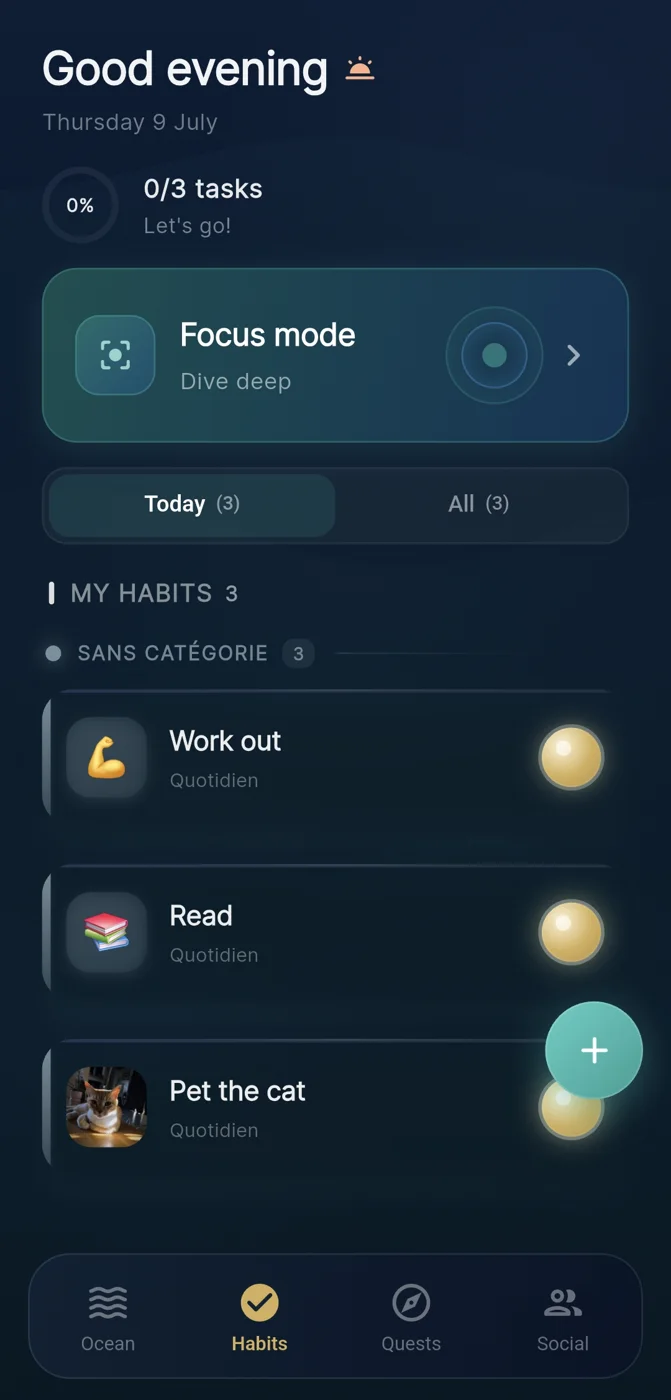
The risk is that tracking becomes the goal. Dense charts and long streak counts can create pressure that makes a single missed day feel like a collapse. Reef's guide to gamified habit trackers discusses this balance; in Reef's own design, each completed habit adds a pearl to a growing ocean scene, a picture of accumulated effort rather than a ranking. Whatever tool you use, ask whether looking at your record leaves you calmer or more anxious, and adjust accordingly.
Plan for missed days before they happen
Missed days are part of any real routine. Illness, travel and ordinary bad days interrupt even well-designed habits. What matters more than an unbroken record is how quickly you return. Deciding your recovery rule in advance removes the moment of negotiation when you are already behind.
A simple rule is never to miss twice in a row, or to fall back to the minimum version after a gap. Some tools build in a buffer for this; Reef, for example, offers a streak freeze for off days and a shrimp companion, Gambi, who responds to a missed day without blame. Tools can soften the moment, but the underlying principle is yours to choose: a gap is a data point, not a verdict.
- Write your restart rule now, while motivation is high.
- After a missed day, do the smallest version rather than catching up.
- Look for the cause of repeated misses instead of adding willpower.
Protect focus time as part of your daily routine
Many people want a better routine because their attention is fragmented. Treating focused work as a habit, with a fixed start cue and a modest duration, often works better than hoping for long uninterrupted stretches. Start with a session length you can finish, then extend it gradually.
Ending on completion matters. A short session you finish builds more confidence than a long one you abandon. Notice what breaks your focus most often, such as notifications, unclear tasks or hunger, and remove one obstacle at a time rather than overhauling your whole environment.
Choose social accountability deliberately, then test it
Sharing a goal with others can help, but it is not universally positive. Some people find a friend checking in motivating; others feel watched and quietly drop the habit. Accountability should be something you opt into for a specific habit, not a default for everything.
Example (hypothetical): Sam wants to walk after lunch and read before bed. Week one, Sam tracks both privately with a minimum of five minutes each. Walking happens four days out of seven; reading happens twice. Sam keeps walking as is, shrinks reading to one page, and invites a colleague to share only the walking habit. At the end of week two, Sam reviews whether sharing helped or added pressure and decides whether to continue. The point is the review cycle, not the numbers.
- Is this habit small enough for a bad day?
- Can I see my progress without feeling judged?
- Do I know my restart rule after a miss?
- Would sharing this habit help, or would I rather keep it private?
- When will I review and adjust?
Frequently asked questions
What is the best first step for improving a daily routine?
Choose one small action you could complete even on a busy or tired day, attach it to something you already do, and repeat it until it feels automatic before adding anything else.
How should I handle a missed day in a new routine?
Decide a restart rule in advance, such as never missing twice in a row or doing only the minimum version after a gap. A missed day is information about your routine, not proof that it has failed.
Does sharing habits with friends make a routine more likely to stick?
It can help some people and add unhelpful pressure for others, and no method guarantees results. Share one specific habit with someone you trust, then review after a week or two whether it is helping.
Sources and further reading
These resources provide the wider reference frame. Product statements on this page are limited to the public information provided by Reef.