 Reef
Reef

Daily routine importance: what the phrase really points to
When people search for daily routine importance, they usually want to know whether structuring their day is worth the effort. The honest answer is that a routine is a tool, not a virtue. Part of its possible value is that some choices you would otherwise renegotiate every morning may start to feel easier to begin when they are tied to a familiar time or a familiar cue.
That framing matters before you act on it. A routine is not a fixed timetable that has to be followed perfectly. It is a small set of repeated actions that support something you already care about, such as reading, moving, studying or protecting a block of uninterrupted work. If a routine does not serve a goal you hold, it tends to become another obligation, and obligations are easy to abandon.
Why repetition may help, and where claims get overstated
A common line of reasoning, offered here as a general observation rather than an established finding, is that repeating an action in a similar context may make it easier to begin, because there can be less to decide each time. Whether that holds in your own life is worth checking against your actual days rather than assuming. What is more certain is that seeing you have done something several days in a row gives you information: you learn which habits fit your life and which only fit your intentions.
Where advice goes wrong is in promising transformation. Articles often imply that the right morning sequence will fix productivity, mood or health. Nobody can promise that. People differ in energy patterns, caring duties, work schedules and health, and a routine that suits one person can be unworkable for another. Treat any claim of a guaranteed outcome, including from habit apps, with caution.
Limits to understand before building a routine
The first limit is rigidity. A routine with too many steps breaks the first time a day goes differently, and a broken chain can feel like failure even when nothing important was lost. The second limit is measurement: tracking what is easy to count can crowd out what actually matters, so you end up optimising checkmarks instead of the underlying goal.
The third limit is scope. A routine can support sleep, movement or focus, but it is not a substitute for professional help if you are dealing with a health condition, persistent low mood or exhaustion. If a routine feels like it is making things worse, that is a signal to simplify it or speak to a qualified person, not to push harder.
A checklist for deciding what belongs in your routine
Before adding anything, test each candidate habit against a few questions. The aim is to keep only actions that are small enough to repeat on a bad day, visible enough that you notice progress, and forgiving enough that one miss does not end the experiment.
Use the list below as a decision aid. If a habit fails two or more of these checks, shrink it or postpone it rather than forcing it in.
- Size: can you complete it in a few minutes on your most tiring day?
- Cue: is it attached to something that already happens, such as making coffee or closing your laptop?
- Visibility: will you be able to see, at a glance, how often you have done it?
- Recovery: do you know what you will do the day after a miss, without starting over from zero?
- Choice of company: would sharing it with others help you, or would it add pressure you do not want?
- Purpose: can you name in one sentence why this habit is worth keeping?
Worked example: rebuilding a routine after a missed week
Example (hypothetical): Sam wanted a routine of thirty minutes of reading, a morning run and a focused work block before email. After a busy week, all three had lapsed, and restarting the full set felt impossible. Using the checklist, Sam cut reading to five pages after dinner, replaced the run with a ten-minute walk after breakfast, and kept a shorter focus block of twenty-five minutes.
The key change was planning for misses in advance. Instead of treating a skipped day as a reset, Sam decided that one missed day would simply be noted and the habit resumed the next day. In a tracker such as Reef, that kind of recovery is built into the design: a streak freeze can cover an off day, and the shrimp companion Gambi acknowledges a missed day without scolding. This example illustrates a decision process, not a measured result.
Where a habit tracker fits, and where it does not
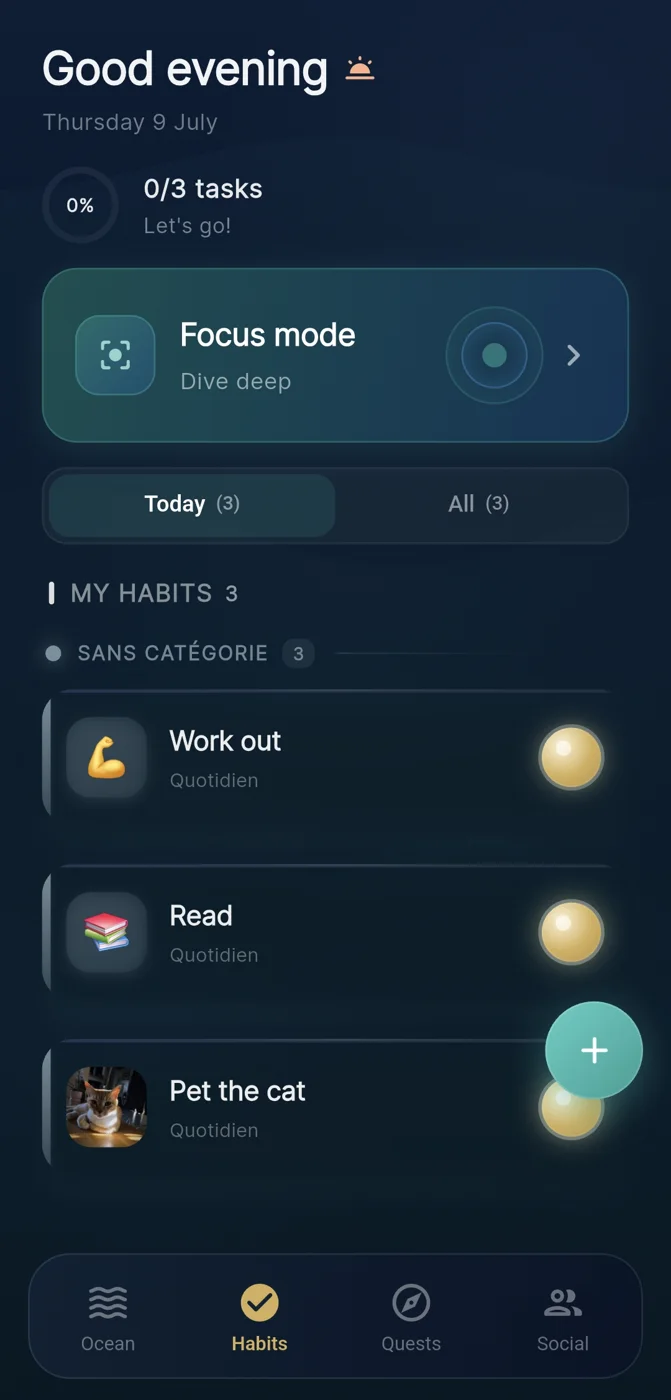
A tracker can help with the visibility part of a routine. Reef, an IVRYN habit app for iOS and Android, turns each finished habit into a pearl that gradually fills a living ocean on screen, and longer focus sessions are shown as a dive that descends through five zones toward the abyss. Joining a crew for shared accountability is entirely optional, and Reef is explicit that it cannot guarantee any change in behaviour or health.
That boundary is the useful takeaway. An app can make repeated actions easier to see and gentler to resume, but the decisions about which habits matter, how small to make them and when to stop belong to you. Reef publishes how its habit mechanics are designed in its methodology page, and its guide to gamified habit trackers discusses when game-like rewards help and when they distract. Both are worth reading before you commit to any tool.
Frequently asked questions
Why is a daily routine considered important?
Many people find that a daily routine can reduce the number of small decisions they face each day, which may make it easier to start actions they value, such as reading or focused work. Its importance depends on whether it supports goals you genuinely hold. It does not guarantee better productivity, mood or health.
What should I do after missing a day of my routine?
Treat a missed day as information rather than failure, and resume the habit the next day without restarting from zero. Deciding in advance how you will recover makes a lapse less discouraging. If misses keep happening, shrink the habit until it fits your hardest days.
Do I need to share my routine with other people to stick to it?
No. Shared accountability helps some people and adds unwelcome pressure for others. It is worth trying only if you find that knowing someone else can see your progress motivates you; otherwise, private tracking and small, repeatable habits are a reasonable approach.
Sources and further reading
These resources provide the wider reference frame. Product statements on this page are limited to the public information provided by Reef.