 Reef
Reef

What people actually mean by best habit tracker excel template
When someone searches for the best habit tracker excel template, they're usually looking for a free, customisable grid where they can log daily actions without signing up for another app. The appeal is real: a spreadsheet is private, offline-friendly, and endlessly adjustable. But 'best' depends heavily on what you plan to track and how much friction you can tolerate before you stop updating it.
A good template should let you log a handful of small repeatable habits, not twenty aspirational ones. The more columns and formulas a template has, the more setup time it demands before you've done anything useful. If you're choosing between templates, favour the one that gets you logging within five minutes over the one with the most conditional formatting.
Strengths of a spreadsheet-based tracker
Excel and Google Sheets templates give you full control over your data. Nothing is locked behind an account, nothing syncs to a company's servers unless you choose to save it there, and you can adapt columns to match habits that don't fit any app's preset categories. For people who track unusual metrics, or who want a private log with no notifications, this is a genuine advantage.
Spreadsheets also make visible progress easy to build yourself. A simple checkbox grid, or a streak counter formula, turns a month of effort into something you can see at a glance. That visibility is one of the more consistently useful features of any habit system, spreadsheet or app, because seeing a pattern is often what keeps people going.
- Full control over data and format
- No account or subscription required
- Easy to customise for unusual or personal habits
- Works offline and keeps data local
Where excel templates fall short
The main limit of a spreadsheet is that it depends entirely on you remembering to open it. There's no reminder, no visual reward beyond what you build yourself, and no gentle nudge after a missed day. For habits that need external structure, that lack of built-in accountability can be the difference between a tracker you use for a week and one you use for a year.
Recovery after a missed day is another weak spot. Most templates simply show a blank cell or a broken streak, which can feel discouraging rather than motivating. A well-designed habit system should make it easy to pick back up without erasing the sense of progress you'd already built, and that's harder to engineer in a static grid than it sounds.
Social accountability, when someone wants it, is also awkward to replicate in a spreadsheet. Sharing a file with a friend works, but it lacks the lightweight, opt-in feel of checking in with a group inside an app built for that purpose.
A worked example: choosing between a template and an app
Example only, not a recommendation of specific outcomes. Imagine someone wants to track three habits: drinking water, a ten-minute walk, and reading before bed. They start with a downloaded Excel template with color-coded streaks. For the first ten days, it works well because they're motivated and check it each morning.
By week three, they miss two days in a row, the streak resets to zero, and the sheet starts to feel like evidence of failure rather than a tool for progress. This is a common pattern with static templates: the format that felt satisfying when things were going well can feel punishing when they aren't.
At this point, the useful question isn't 'which template is best' but 'do I need built-in recovery and gentle prompts, or am I disciplined enough to maintain this myself.' If the honest answer is the former, a lightweight app with visual progress and optional social check-ins may serve better than a more elaborate spreadsheet.
How best habit tracker excel template searches connect to app alternatives
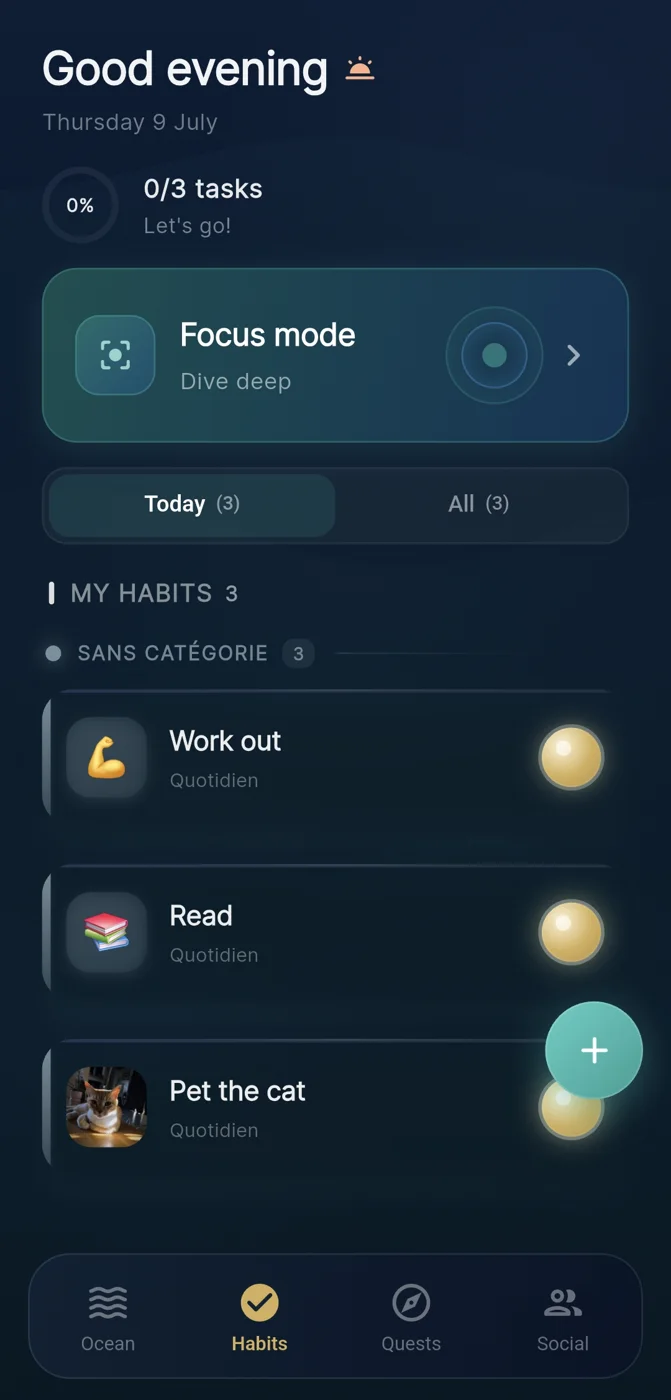
Reef, an IVRYN mobile habit tracker for iOS and Android, is one option in this space worth understanding on its own terms rather than as a spreadsheet replacement by default. It represents completed habits as pearls that build into a visual living ocean, which gives the same kind of visible-progress payoff a well-built spreadsheet aims for, but without needing you to design the formatting yourself.
Reef also includes focus sessions framed around a dive metaphor, rewarding completed focus time with pearls in the same visual system, and optional social crews for people who want light accountability from others. None of this guarantees a particular outcome or behaviour change; it simply automates some of the structure that a spreadsheet leaves for you to build by hand.
The decision between a template and an app like this comes down to whether you value full manual control (spreadsheet) or built-in visual reinforcement and gentle recovery mechanics with less setup (app). Neither is universally 'best'; the right choice depends on how much structure you personally need to keep the habit going.
A simple checklist before you commit
Before settling on a habit tracker excel template, or deciding an app suits you better, it helps to check a few things against your own habits rather than the tool's feature list.
- Can you realistically open this tool at the same point in your day, every day?
- Does the format show you a missed day without making you want to quit?
- Are you tracking 2-4 genuinely small habits, not a long aspirational list?
- Do you want any social accountability, even occasionally, or is full privacy the priority?
- Will you still find this format motivating after a bad week, not just a good one?
Frequently asked questions
Is an Excel template better than a habit tracking app?
Neither is universally better. A spreadsheet gives full control, privacy and customisation but depends entirely on your own discipline and design choices, while an app can automate visual progress and gentle recovery after missed days. The right choice depends on how much built-in structure you personally need.
What should a good habit tracker template include at minimum?
At minimum, it should track a small number of specific habits, show progress in a way that's easy to glance at, and handle a missed day without feeling punishing. Overly complex templates with many columns often create setup friction that reduces the chance you'll keep using them.
Can a habit tracker guarantee behaviour change?
No tracker, spreadsheet or app, can guarantee a behaviour or health outcome. Tracking tools make progress visible and can support consistency, but the underlying habit change still depends on the person's own circumstances and effort.
Sources and further reading
These resources provide the wider reference frame. Product statements on this page are limited to the public information provided by Reef.