 Reef
Reef

Why people search for a habit tracker app without subscription
Someone typing 'habit tracker app without subscription' into a search bar is usually reacting to two things at once: a bad experience with a paywalled app that locked basic features behind recurring fees, and a genuine worry that paying monthly for a habit tool is a strange incentive structure. If the app only benefits from you staying subscribed, its business model doesn't automatically align with you actually finishing the habit and needing it less.
This is a fair concern, but it's worth separating from the actual question that matters more: does the app help you notice and repeat small actions consistently, and does it recover gracefully when you miss a day? A pricing model tells you about the business, not about whether the design supports habit formation. Both matter, but they're different questions and should be evaluated separately.
What 'without subscription' actually covers
Before comparing apps, it helps to be precise about what 'no subscription' means, because the phrase covers several very different arrangements: a one-time purchase that unlocks everything permanently, a free app with an optional one-time unlock for extra features, a free app that stays free with no premium tier, or a free tier that is functionally complete but nudges you toward an optional paid upgrade.
Pricing details, free-tier limits and which unlock model any given app uses can change over time, so treat specific current offers as something to verify at the point of download rather than a fixed fact. What's more durable is asking whether the core mechanic you'll use daily - logging a habit, seeing a streak, seeing some kind of accumulating visual progress - is available without ongoing payment, regardless of how a particular app structures its pricing today.
The habit-design questions that matter more than price
A subscription-free app that doesn't support real habit formation isn't a good trade. The more useful evaluation criteria are about design, not billing. First: does progress become visible in a way that's quick to check and doesn't require interpretation? Second: does the app treat a missed day as data rather than a failure state - for example, resuming a streak or visual gently rather than resetting everything to zero and implicitly punishing you? Third: if the app has any social or accountability layer, is it optional, or does it pressure you to perform for other people, which can undermine intrinsic motivation for some users.
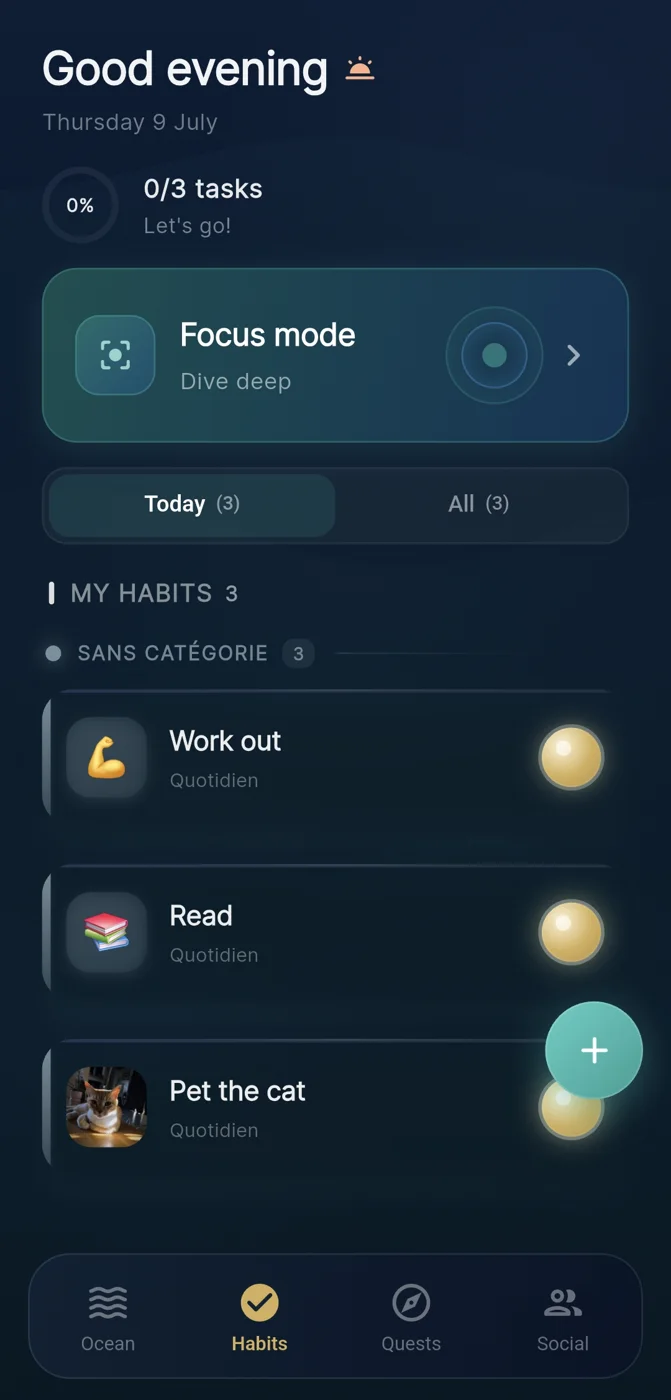
Reef, an IVRYN habit and focus app for iOS and Android, is one example of a design built around these ideas rather than around subscription mechanics specifically. Completing a habit in Reef adds a pearl to a visual ocean that accumulates over time, which is meant to make consistency visible at a glance rather than through numbers alone. Focus sessions use a dive metaphor and also earn pearls for completed focus time, and any social 'crew' feature is optional rather than required. None of this is a claim that Reef or any app guarantees a behaviour change - it's a description of mechanics, and whether they suit a given reader is something only that reader can judge against their own habits.
A worked example: comparing two hypothetical apps
Here is a hypothetical, illustrative comparison - not a review of real products - to show how the criteria above apply in practice. Imagine 'App A' is free with no subscription at all but resets your streak to zero after any missed day and offers no other form of progress visualisation. Imagine 'App B' has an optional one-time purchase for extra habit categories, but its free tier includes unlimited habits, a softer 'recovery' state after a missed day (so you don't lose all visible progress), and no forced social features.
On price alone, App A looks like the safer choice because there's no purchase at all. But on habit-design grounds, App B may better support the core principles that make tracking useful long-term: small repeatable habits stay visible, a missed day doesn't erase everything, and any social layer is opt-in. This example is meant only to illustrate how to weigh criteria against each other - it isn't a recommendation of any specific real app, and actual apps' pricing and features should be checked directly before deciding.
A short checklist before you download
Given the above, a practical way to evaluate any habit tracker app without subscription is to check a short list of things before committing time to it, rather than choosing based on price alone.
- Confirm what the free tier actually includes today, since this can change - don't rely on older reviews or memory
- Check whether missed days reset progress entirely or allow some form of gentle recovery
- Look at whether progress is visible in a quick, low-effort way (a visual, a count, a streak) rather than buried in menus
- Confirm any social or accountability feature is optional, not required to use the app
- Decide in advance how you'll judge whether it's working for you after two to four weeks, rather than judging on day one
What this advice can't tell you
No article, including this one, can tell you which specific app will work for your habits, because that depends on your own patterns, what you're trying to build, and how you respond to visual feedback versus numeric feedback. This piece also can't make claims about outcomes: no habit tracker, subscription-based or not, guarantees that you'll build or maintain a habit, and any tool that implies otherwise is overstating what software can do.
It's also worth being cautious about anything in this space that reads like a performance guarantee or a claim of scientifically proven results attached to a specific app, since habit formation is affected by many factors outside any single tool's control. Treat the criteria in this article as a way to filter options faster, not as a promise about what will happen once you start using one.
Frequently asked questions
Is a one-time purchase habit tracker always a better deal than a subscription one?
Not necessarily - it depends on how much ongoing development and feature support you expect to need. A one-time purchase can be better value if the app already does what you need, but a subscription can make sense if it funds continued updates you'll rely on. The pricing model alone doesn't determine whether the app supports good habit formation, so it's worth evaluating both separately.
What's the biggest habit-tracking design flaw to avoid, regardless of pricing?
Apps that fully reset your progress or streak after a single missed day, with no gentler recovery option, tend to punish normal lapses rather than support consistency. Since occasional missed days are expected, look for a design that treats a miss as something to recover from rather than a reason to start entirely over.
Does using a habit tracker app guarantee I'll build the habit I'm targeting?
No. No habit tracker, regardless of price or design, can guarantee a behaviour or health outcome - tools can make progress visible and reduce friction, but actually repeating the habit still depends on the person. Be cautious of any app or article that implies otherwise.
Sources and further reading
These resources provide the wider reference frame. Product statements on this page are limited to the public information provided by Reef.